
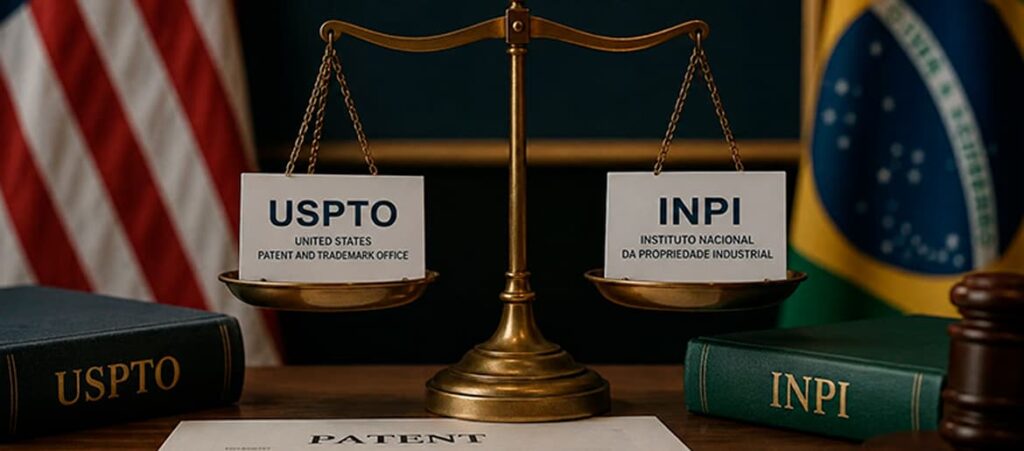
For companies seeking international patent protection, understanding the differences between the United States Patent and Trademark Office (USPTO) and the Brazilian Patent and Trademark Office (INPI) is essential. Although both offices aim to protect innovation and encourage technological development, their procedures, timelines, and legal requirements differ significantly.
A patent strategy that works in the United States may not necessarily produce the same results in Brazil. Foreign applicants should be aware of these distinctions before filing a patent application or entering the Brazilian market.
Understanding the Brazilian patent system
Brazil has become an increasingly attractive jurisdiction for patent protection due to its large consumer market, strong industrial sectors, and recent efforts to improve examination efficiency.
The Brazilian Patent and Trademark Office (INPI) is responsible for administering patent applications and granting exclusive rights to inventors. Unlike the USPTO, however, the Brazilian patent system follows several procedural rules that require careful planning by foreign applicants.
Types of Patents Available
The INPI offers three primary forms of patent protection:
Invention Patents
Invention patents protect new products or processes that involve an inventive step and are capable of industrial application. Protection is granted for twenty years from the filing date.
Utility Models
Utility models protect practical improvements to existing objects that result in functional enhancement. This form of protection is available for fifteen years from the filing date.
Certificates of Addition
Brazil also allows Certificates of Addition, which protect improvements or developments related to a previously filed invention patent without requiring a new inventive concept.
By comparison, the USPTO provides utility patents, design patents, and plant patents, each with its own legal requirements and scope of protection. While utility and plant patents have 20-years term counted from the filing date, the design patent enjoys 15 years from the date of grant.
Examination Procedures: One of the biggest differences
One of the most important distinctions between patent registration in Brazil and the United States concerns the examination request.
Examination before the INPI
In Brazil, filing a patent application does not automatically trigger substantive examination. Applicants must formally request examination within thirty-six months from the filing date.
For PCT applications entering the Brazilian national phase, this deadline is calculated from the international filing date.
Failure to request examination within this deadline results in the application being definitively abandoned.
Important remark: The examination line is counted from the request for examination and not from the filing date.
Examination before the USPTO
The USPTO automatically initiates examination after filing and payment of the required fees. Applicants do not need to submit a separate examination request.
This procedural difference often surprises foreign companies that are unfamiliar with the Brazilian patent system.
Patent Drafting Considerations: Brazil vs. United States
Patent specifications drafted for the United States often require significant adaptation before being filed in Brazil.
Claim structure requirements
The Brazilian Patent Office generally requires separate independent claims for products, processes, systems, devices, and uses when multiple statutory categories are involved.
Mixing different categories within a single independent claim may trigger clarity or formal objections during examination.
In contrast, U.S. practice often allows greater flexibility in claim drafting and claim set organization.
Use of preferred embodiment language
Another important distinction involves the use of expressions such as “preferably,” “more preferably,” and similar terminology.
Such language is commonly accepted by the INPI and frequently appears throughout Brazilian patent specifications.
In the United States, however, excessive reliance on these expressions may create claim interpretation concerns or unnecessary limitations during litigation and prosecution. U.S. patent practitioners often prefer alternative drafting approaches.
Because of these differences, patent applications prepared for one jurisdiction should not be automatically replicated in the other without a careful review of local drafting requirements.
A filing strategy that works well before the USPTO may generate formal objections, clarity issues, or unnecessary prosecution costs before the INPI.
Examiner Interaction During Patent Prosecution
Patent prosecution practices also differ considerably between the two offices.
Communication with the INPI
The Brazilian examination process is primarily document-based. Most interactions occur through written submissions, technical arguments, and responses to office actions.
Direct interviews with examiners are uncommon.
Communication with the USPTO
The USPTO offers a more interactive environment, allowing applicants and attorneys to conduct examiner interviews and discuss issues directly during prosecution.
This distinction often influences filing strategies and response approaches in each jurisdiction.
Divisional Applications and Portfolio Strategy
Applicants should also be aware of important differences regarding divisional applications.
Brazil permits divisional filings, but the mechanism is more restrictive than its American counterpart. Divisional applications must comply with unity of invention requirements, and improper division may result in procedural complications or loss of rights. Divisions may be filed before a decision of first stage, meaning before Notice of Allowance or Notice of Rejection.
The USPTO, on the other hand, offers several continuation strategies, including continuation and continuation-in-part (CIP) applications, providing greater flexibility for portfolio management.
As a result, patent strategies developed for the United States often require adjustments before being implemented in Brazil.
What cannot be patented in Brazil?
Subject matter eligibility is another area where foreign applicants frequently encounter surprises.
Brazilian patent law adopts a more restrictive approach than the United States.
Generally, the following are not considered patentable subject matter in Brazil:
- Software per se
- Business methods
- Pure operational methods
- Abstract ideas
- Mathematical methods
By contrast, software-related inventions and certain business method patents may receive protection in the United States when specific legal requirements are met.
Understanding these limitations is essential when evaluating patent protection in Brazil.
Accelerated Examination Programs
Both countries offer mechanisms to speed up patent prosecution.
Fast-Track Options in Brazil
The INPI currently provides accelerated examination through programs such as:
- Patent Prosecution Highway (PPH)
- Green technology initiatives
- Technologies already commercialized in Brazil
- Specific priority programs for eligible applicants
These initiatives can substantially reduce examination times compared to the ordinary procedure.
Fast-Track Options in the United States
The USPTO offers similar alternatives, including:
- Track One Prioritized Examination
- Patent Prosecution Highway (PPH)
- Green technology programs
Choosing the appropriate acceleration mechanism can significantly improve the speed of patent registration in Brazil and the United States.
Maintenance fees and long-Term costs
Another important distinction involves maintenance fees.
In Brazil, annual fees become due beginning in the third year after the national filing date (or from the PCT international filing date), regardless of whether the patent has already been granted.
In the United States, maintenance fees are generally linked to the post-grant phase and follow a different payment schedule.
Companies managing international patent portfolios should account for these differences when forecasting long-term protection costs.
Strategic considerations for foreign applicants
Many foreign companies mistakenly assume that patent applications can be replicated across jurisdictions without modification. In practice, successful patent registration in Brazil often requires adaptation to local legal requirements, procedural deadlines, and examination practices.
Applicants should pay particular attention to examination request deadlines, divisional filing strategies, subject matter eligibility, and opportunities for accelerated examination.
A carefully tailored approach can reduce prosecution risks, improve efficiency, and strengthen patent protection throughout Latin America.
Conclusion
Although the USPTO and the INPI share the common goal of protecting innovation, the procedures governing patent registration differ significantly. Understanding these differences is essential for companies seeking effective patent protection in Brazil.
Foreign applicants who take local requirements into account from the outset are better positioned to secure valuable patent rights, avoid procedural pitfalls, and maximize the commercial value of their innovations in one of the largest markets in the world.
Need assistance with patent registration in Brazil? CNV’s patent team supports foreign companies throughout every stage of the Brazilian patent application process, from filing strategy to grant and portfolio management.